Originally published on Medium.
Think of a message queue like a school cafeteria line. Each student (producer) writes down their lunch order on a piece of paper (message) and puts it in a box (queue). The cafeteria workers (consumers) take one order at a time from the box and prepare the lunch. Even if a lot of students put their orders in the box at the same time, the cafeteria workers can still make the lunches one by one. This way, everyone gets their lunch, and the cafeteria workers don’t get overwhelmed.
What is a Message Queue?
A message queue is a mechanism for asynchronous communication between services, commonly used in serverless and microservices architectures. It enables different components of a system to communicate and perform tasks independently by decoupling the sending and receiving processes. Essentially, a message queue serves as a buffer that temporarily holds messages (such as tasks, data, or events) until they are retrieved and processed by the receiving service. This approach enhances system reliability, scalability, and maintainability by allowing services to function and scale independently.
Key Concepts:
Producer and Consumer: Producer is the entity that sends messages to the queue. Consumer is the entity that retrieves and processes messages from the queue.
Message: A discrete unit of data passed between the producer and the consumer via the queue. Messages can contain various types of information, such as job instructions, event notifications, or data payloads.
{
  "orderId": "12345",
  "customerId": "67890",
  "items": [
    {"itemId": "abc", "quantity": 2},
    {"itemId": "def", "quantity": 1}
  ],
  "orderTimestamp": "2023-05-25T15:30:00Z"
}
Queue: A data structure that holds messages until they are processed. The queue ensures that messages are delivered in a reliable and ordered manner.

Why Use Message Queues?
- Decoupling: Message queues enable different components of a system to function independently by acting as intermediaries between producers and consumers. This allows producers to send messages at their own pace and consumers to process those messages at a different rate, without causing disruptions. As a result, message queues enhance system modularity and flexibility, allowing each part of the system to scale and evolve independently.
- Scalability: By decoupling services, message queues enable systems to scale more effectively. Additional consumers can be added to process the queued messages, allowing the system to handle increased loads.
- Reliability: Message queues provide reliability through features like message persistence and delivery guarantees. Even if a consumer fails, the messages remain in the queue until they are successfully processed.
- Load Balancing: Queues can distribute work among multiple consumers, ensuring that no single consumer is overwhelmed, which enhances system performance and resource utilization.
Popular Message Queue Implementations:
- RabbitMQ: A widely-used open-source message broker that implements the Advanced Message Queuing Protocol (AMQP). It supports various messaging patterns and provides robust features like message acknowledgments and persistent storage. Use Case: Reddit uses RabbitMQ to manage its message queue for handling a variety of tasks. This includes background job processing, real-time message delivery, and coordination between microservices. Reason for Choice: RabbitMQ’s support for multiple messaging patterns, robust features like message acknowledgments, persistent storage, and its reliability in delivering messages make it suitable for handling Reddit’s diverse and high-volume message traffic.
- Apache Kafka: A distributed streaming platform often used for building real-time data pipelines and streaming applications. Kafka is known for its high throughput and fault tolerance. Use Case: Netflix uses Apache Kafka for real-time data streaming to monitor the state of its distributed systems. Kafka helps in collecting and processing event data from various microservices. Reason for Choice: Kafka’s distributed nature, scalability, and fault tolerance are essential for Netflix’s large-scale, real-time data processing requirements.
- Amazon SQS (Simple Queue Service): A fully managed message queuing service by AWS. It offers scalability, durability, and ease of use, making it a popular choice for cloud-based applications. Use Case: Airbnb uses Amazon SQS to decouple components of its application. SQS helps in managing background jobs, handling asynchronous processing, and ensuring reliable communication between microservices. Reason for Choice: SQS’s fully managed nature, ease of use, scalability, and integration with other AWS services make it ideal for Airbnb’s cloud-based architecture.
- ActiveMQ: An open-source message broker that supports multiple messaging protocols. It is often used in enterprise environments and provides features like clustering and message routing. Use Case: JPMorgan Chase uses ActiveMQ for processing financial transactions and ensuring reliable communication between different parts of their financial systems. Reason for Choice: ActiveMQ’s reliability, support for JMS (Java Message Service), and its ability to handle the demands of a financial institution with high transaction volumes and stringent reliability requirements.
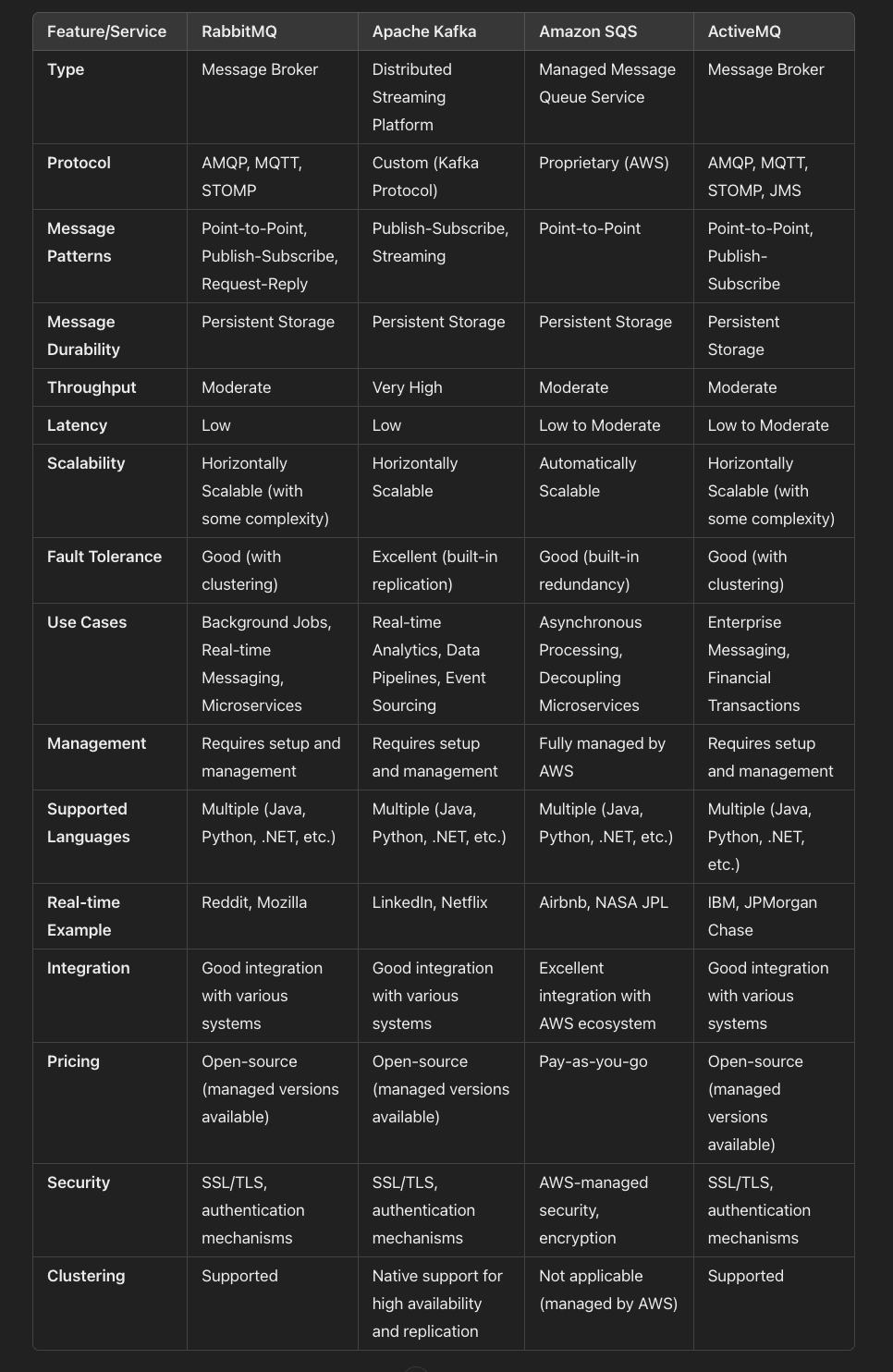
Common Message Queue Patterns:
Point-to-Point: In this pattern, each message is delivered to a single consumer. It is typically used for tasks like job processing, where each task should be handled by one worker.
Scenario: A web application generates tasks that need to be processed, such as resizing images. Each task is sent as a message to a RabbitMQ queue. A pool of workers listens to the queue and processes tasks one by one. Each task is consumed by a single worker, ensuring that tasks are not processed multiple times.
Technology: RabbitMQ
Message Flow: Producer: The web application sends a task to the RabbitMQ queue → Queue: The message is stored in the queue → Consumer: A worker retrieves and processes the task from the queue.
Publish-Subscribe: This pattern allows messages to be broadcast to multiple consumers. It is useful for event-driven architectures where multiple services need to react to the same event.
Scenario: In a financial trading platform, real-time stock price updates need to be broadcast to multiple services, such as a trading dashboard, a risk management system, and a notification service for traders. Using the publish-subscribe pattern with Amazon SNS, a stock price update can be published to an SNS topic, and multiple subscribers can receive the update simultaneously.
Technology: Amazon SNS (Simple Notification Service) and Amazon SQS (Simple Queue Service)
Message Flow: Publisher: Stock price data feed publishes the update to an SNS topic → SNS Topic: Broadcasts the update to all subscribed endpoints, including SQS queues. → Subscribers: Trading Dashboard: Receives real-time updates directly from SNS. Risk Management Queue (SQS): Receives updates for risk recalibration. Notification Service Queue (SQS): Receives updates for sending alerts. Analytics Queue (SQS): Receives updates for data analysis and storage.
Request-Reply: A pattern where a service sends a request message and waits for a reply message. This is often used in RPC (Remote Procedure Call) systems.
Scenario: Order Status Inquiry Service
Technology: RabbitMQ
Message Flow: Client: A user requests the status of their order through a web application. The request is sent to a RabbitMQ request queue → Server: The server listens for requests on the RabbitMQ request queue. When a request is received, the server processes the request by checking the order status in the database and then sends a reply message to a dedicated reply queue. → Client: The client listens for the reply message on the reply queue and processes the response to display the order status to the user.
Best Practices for Using Message Queues:
- Idempotency: Ensure that message processing is idempotent, meaning that processing the same message multiple times has the same effect as processing it once. This prevents issues from message duplication.
- Monitoring and Alerting: Implement robust monitoring and alerting for your message queue system. Track metrics like queue length, processing time, and error rates to identify and address issues promptly.
- Dead Letter Queues (DLQ): Use DLQs to handle messages that cannot be processed successfully after multiple attempts. This helps in isolating problematic messages and ensures they do not block the queue.
- Backpressure Management: Implement strategies to handle backpressure, such as rate limiting or shedding load, to prevent system overload when the message production rate exceeds consumption capacity.
Conclusion:
Message queues are a crucial component in modern system design, facilitating asynchronous communication, scalability, and reliability. By grasping their concepts, patterns, and best practices, you can effectively utilize message queues to build robust and scalable systems.