Originally published on Medium.
Introduction
Have you ever wondered why computers seem to love the number 2 so much? Well, it all starts with something called the binary system, which is the foundation of all computing. In this article, we’ll explore why the number 2 is so important, how it works, and how it’s used in computer science and various applications.
The Magic of the Number 2
What is Binary?
- Binary System: The binary system is like the language of computers. Instead of using ten digits (0–9) like we do in the decimal system, binary only uses two digits: 0 and 1.
- Base of 2: Binary is a base-2 system, which means every number is represented using only the digits 0 and 1.
Why Base 2?
Computers are built using millions of tiny switches called transistors. These switches can be either off (0) or on (1). Using binary makes it simple for computers to store and process information because it matches the physical nature of the hardware.
What are Transistors? Transistors are tiny electronic devices that act as switches in a computer. They can be in one of two states: off (0) or on (1).
How They Work: When electricity flows through a transistor, it turns on (1). When there is no electricity, it turns off (0). These simple on/off states are the foundation of all computer operations.
Storing Data: Each bit of data (binary digit) is represented by a transistor. For example, the binary number 1011 is represented by four transistors in the states: on (1), off (0), on (1), and on (1).
Characters in Binary: To represent characters like “A”, computers use a standard encoding system called ASCII (American Standard Code for Information Interchange). Each ASCII character is represented using 8 bits (1 byte). For example, the character “A” is represented by the binary number 01000001.
Example: Representing “A” in Binary:
- The ASCII value for “A” is 65.
- The binary representation of 65 is 01000001.
- Transistors Needed: Each bit in the binary representation of “A” corresponds to a transistor. Therefore, it takes 8 transistors to represent the character “A”.
Powers of 2 are the foundation of the binary system. Each bit (binary digit) in a computer represents a power of 2.
Computer memory and storage are often organized in sizes that are powers of 2, like 1 KB (kilobyte) being 1024 bytes (2¹⁰).
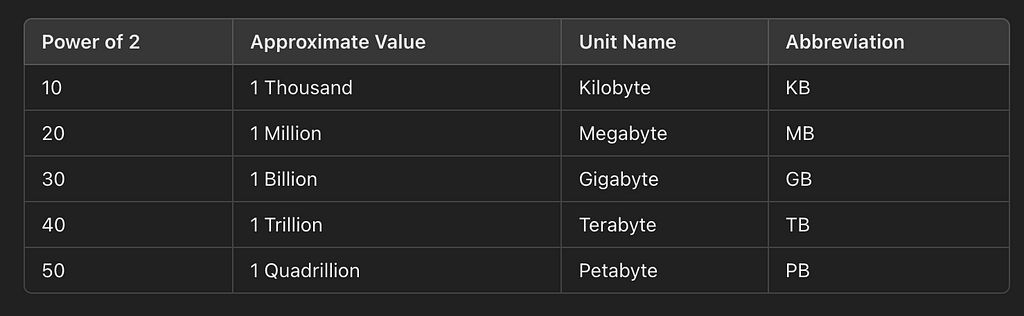
How Computers Use Powers of 2
Memory and Storage:
- Memory Sizes: Memory sizes in computers are always powers of 2. For example: 1 KB = 1024 bytes (2¹⁰) 1 MB = 1024 KB (2²⁰) 1 GB = 1024 MB (2³⁰)
Data Structures:
- Binary Trees: In a binary tree, each node has up to two children. The height and balance of these trees often involve powers of 2.
- Heaps: A binary heap is a special tree-based data structure that satisfies the heap property and relies on binary principles.
Algorithms:
- Divide and Conquer: Algorithms like mergesort and quicksort use a divide-and-conquer strategy, splitting data into halves, leveraging the power of 2 for efficiency.
- Exponentiation by Squaring: This method efficiently computes large powers by breaking the problem into smaller powers of 2.
Networking:
- IP Addresses: IPv4 addresses are 32-bit numbers, allowing for 2³² unique addresses.
- Subnets: Network subnets are often divided using powers of 2 to create efficient and manageable networks.
Why Understanding Powers of 2 is Awesome
Efficiency: Knowing about powers of 2 helps you understand how computers work efficiently. It’s like having a superpower to see behind the scenes of technology.
Problem-Solving: Many problems in computer science can be simplified by understanding powers of 2. It helps in designing faster algorithms and managing data better.
Hardware Design: Hardware engineers design memory, processors, and storage devices around powers of 2. It’s crucial for creating the gadgets and devices we use every day.
Conclusion
The power of 2 is a cornerstone of computer science, forming the basis of binary systems, memory organization, data structures, and algorithms. By understanding how powers of 2 work and their applications, you can gain a deeper appreciation for the technology we use daily and become better at solving problems and designing efficient systems. Whether you’re counting on your fingers or designing the next big app, the power of 2 is your friend in the world of computing.